
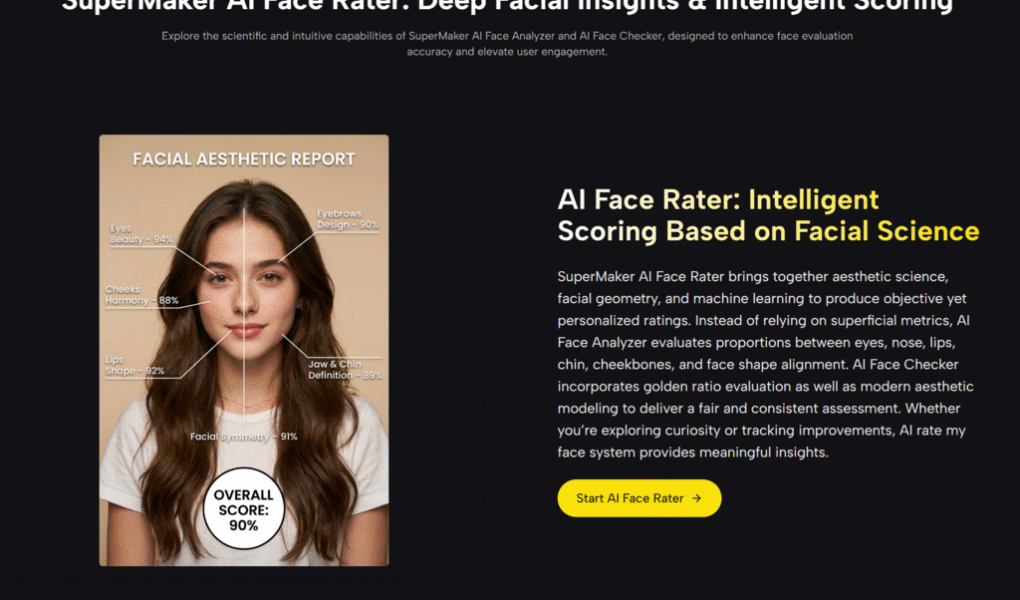
You know that moment when you’re about to post a photo online, and you pause? Not because the picture is bad, but because you genuinely can’t tell if it’s good. You ask your roommate—they say it’s fine. You ask your sister—she suggests a different one. You post it anyway, then spend the next hour wondering if you made the right choice.
Welcome to the paradox of self-perception. We see our faces every single day, yet we’re often the worst judges of our own appearance. Mirrors lie through familiarity. Friends sugarcoat through affection. And that front-facing camera? It’s basically a fun-house mirror with a vendetta.
What if you could strip away all that noise and see your face the way a scientist might examine a specimen—not with judgment, but with genuine curiosity about structure, balance, and proportion? That’s essentially what modern facial analysis technology offers, and tools like AI Face Rater are making this kind of objective assessment accessible to anyone with a smartphone and five minutes of curiosity.
The Science Behind Facial Harmony
Why Some Faces Feel “Balanced”
Here’s something I didn’t know until recently: there’s actual mathematics behind why certain faces feel harmonious to look at. Renaissance artists obsessed over these proportions. Modern plastic surgeons study them extensively. And now, algorithms can measure them in seconds.
The Golden Ratio in Facial Structure
The golden ratio (approximately 1.618) appears throughout nature—in seashells, flower petals, and yes, human faces. When I first learned this, I thought it sounded like pseudoscience. Then I uploaded a photo and watched the analysis map out these proportions on my own face. The areas where my features aligned with this ratio? Those were exactly the features people had complimented over the years.
What Makes Facial Analysis Different from Opinion
Objective Measurement vs. Subjective Preference
| Factor | Friend’s Opinion | Social Media Feedback | AI Face Rater Analysis |
| Measurement Basis | Personal taste and loyalty | Trends and popularity bias | Geometric and proportional data |
| Repeatability | Changes with their mood | Varies by platform and time | Identical for same image |
| Specificity | “You look great!” | Likes without explanation | Detailed feature breakdown |
| Cultural Influence | Heavy personal bias | Algorithm-driven trends | Multiple aesthetic frameworks |
| Usefulness | Emotional support | Validation seeking | Educational understanding |
| Honesty Level | Often filtered kindly | Unpredictably harsh or kind | Neutral and consistent |
My Unexpected Discovery: The Asymmetry We All Share
Testing the Technology on Myself
I decided to run an experiment. I took ten selfies in one sitting—same lighting, same location, just slightly different angles and expressions. Then I ran them all through facial analysis to see what would happen.
What the Numbers Revealed
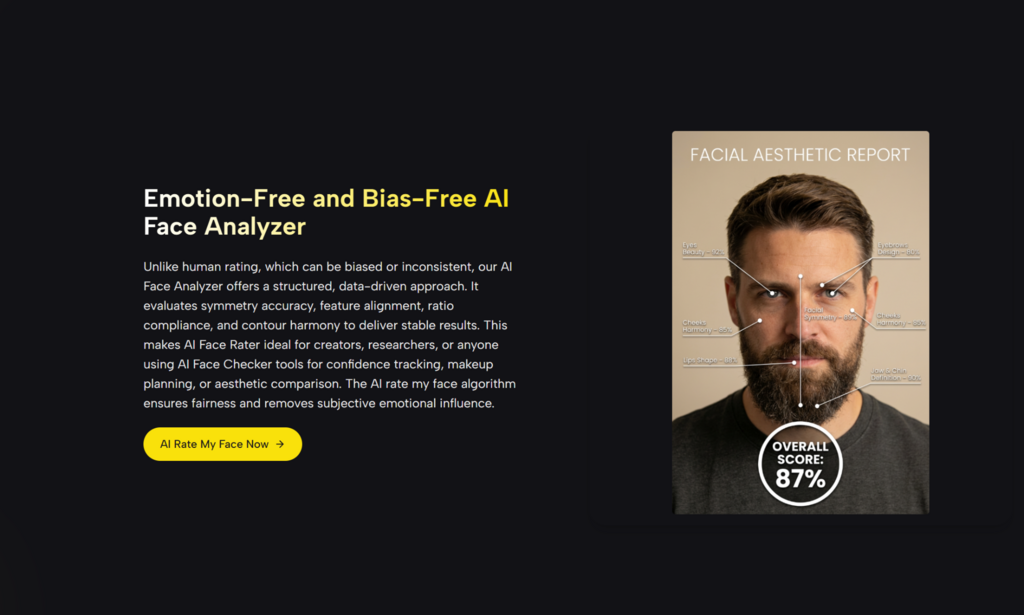
The scores ranged from 6.8 to 8.2 out of 10. At first, I thought the tool was inconsistent. But looking closer, I realized something fascinating: the photos where I tilted my head slightly left scored consistently higher. Why? The analysis revealed that my right side has slightly better symmetry than my left—something I’d never consciously noticed in 30+ years of looking at my own face.
The Asymmetry Truth Bomb
Everyone Has Facial Asymmetry
Here’s what multiple analyses taught me: perfect symmetry doesn’t exist in nature, and that’s completely normal. My left eyebrow sits 2mm higher than my right. One cheekbone is marginally more prominent. These “flaws” aren’t defects—they’re human.
What changed wasn’t my face, but my understanding of it. Instead of vaguely thinking “I look better in some photos,” I now know why certain angles work better for my particular facial structure.
Beyond Vanity: Practical Uses I Actually Found Helpful
Tracking Real Changes Over Time
The Six-Month Skincare Experiment
I started a new skincare routine in July. By December, I felt like my skin looked better, but couldn’t be sure if I was just imagining it. I compared facial analysis from both periods—not just the scores, but the specific measurements around skin texture and facial contours.
The data confirmed subtle improvements I couldn’t quite articulate: more even skin tone distribution, slightly reduced under-eye shadowing. Having objective measurements made the investment in quality skincare feel validated rather than hopeful.
Photography Skills Without the Guesswork
Finding Your Best Angles Scientifically
As someone who occasionally needs professional headshots, I used to rely on photographers to “find my good side.” Now I understand my facial geometry well enough to position myself optimally. It’s not about vanity—it’s about working efficiently with professionals and getting better results faster.
Fitness Progress Beyond the Scale
Facial Structure Changes from Weight Loss
The scale told me I’d lost 15 pounds. The mirror showed… something different? Facial analysis provided concrete data: my jawline definition increased by measurable degrees, facial width-to-length ratio shifted, and cheekbone prominence became more defined. These objective markers helped me see progress that weight numbers alone couldn’t capture.
The Limitations Nobody Talks About
What AI Can’t Measure (And Why That Matters More)
Let me be completely transparent about something: after running dozens of analyses, I’ve concluded that facial scoring technology is interesting but incomplete. It measures structure beautifully. It quantifies proportions accurately. But it misses everything that makes faces memorable.
The Intangible Qualities
| AI Can Measure | AI Cannot Measure | Real-World Impact |
| Symmetry percentage | Warmth of expression | High – people remember feeling |
| Golden ratio alignment | Authenticity | Critical – trust building |
| Feature proportions | Laugh lines’ charm | Significant – personality indicator |
| Jawline definition | Kindness in eyes | Essential – emotional connection |
| Facial thirds balance | Confidence energy | Dominant – presence matters most |
The most attractive person I know scores a 7.1 on facial analysis. But when she walks into a room, everyone notices—not because of geometric perfection, but because of presence, warmth, and genuine confidence.
How to Use This Technology Wisely
The Healthy Approach
Do: Use It for Understanding
Treat facial analysis like a mirror with measurements—a tool for understanding your features better, not judging your worth. I check my analysis maybe once every few months, usually when I’m curious about changes from fitness or skincare routines.
Don’t: Use It for Validation
If you find yourself checking your score daily or feeling genuinely distressed about the numbers, step back. These tools measure one narrow aspect of appearance—facial geometry—while ignoring the dozens of factors that actually make someone attractive in real life.
The Verdict: Interesting Data, Not Life-Changing Truth
What I’ve Learned After Three Months
AI Video Generator Agent is genuinely fascinating from a scientific perspective. It’s taught me more about facial anatomy than I learned in school. It’s helped me understand why certain styling choices work better for my face shape. And occasionally, it’s provided useful data for tracking aesthetic changes over time.
But here’s what it hasn’t done: changed how I feel about my appearance in any fundamental way. Because at the end of the day, the number on the screen is just geometry. It doesn’t measure the way my face lights up when I see my nephew, or how my expression shifts when I’m passionate about something, or the laugh lines that come from years of genuine joy.
Use these tools if you’re curious. Learn from them if you find the data interesting. But never mistake a facial analysis score for a measure of your attractiveness, your worth, or your ability to connect with others. Those qualities live far beyond what any algorithm can measure.