
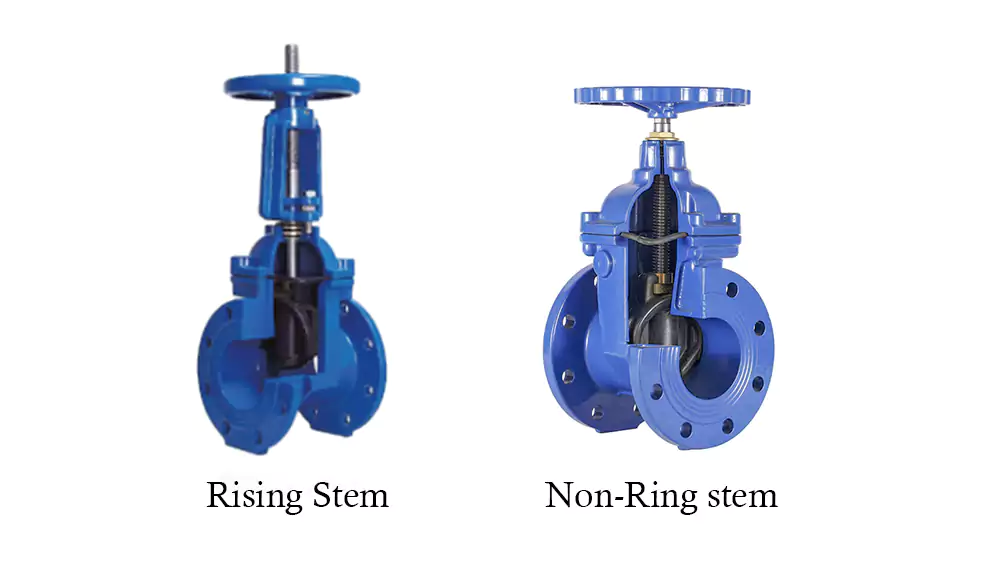
The gate valves are commonly utilized in piping systems. They can regulate the flow of the fluid by raising or stabilizing a gate. These valves are the ones used in water, oil, and gas lines. Various designs of the gate valves are applicable to various uses. There are two common designs, which are rising stem and non-rising stem gate valves. Knowledge of the rising vs non-rising stem gate valves assists in estimating the correct valve to use.
Basic Working of a Gate Valve
A flat or wedge-shaped gate is an element of a gate valve that regulates flow. The gate is raised to get the flow. It moves down to stop the flow. The most suitable kind of gate valves are fully opened or closed. They cannot be throttled quite well.
The handwheel is connected via the stem to the gate. As the handwheel spins, the stem acts as the gate. The type of valve is defined as the stem motion.
Rising Stem Gate Valve: What Is a RisingStem Gate Valve?
In an ascending stem gate valve, the stem vibrates either vertically. The stem rises at the time of opening of the valve. The reduction of this is experienced during the closing of the valve. This movement is evident with reference to the outside of the valve body.
The stem is perforated on the external side. This makes it easy to lubricate it. The operators are then able to observe the position of the valve. This design is usually used in outdoor installation.
Merits of Rising Stem Gate Valves.
The developing stem valves are easily observed. Operators will be able to determine whether the valve will be open or closed. This enhances security in operations. Extrinsic threads remain hygienic and available.
It is easier to maintain in this design. The working of a lubrication can be performed without the dismantling of the valve. These valves can be used in a clean environment. Most industries use them in above-ground pipelines.
What Is the Non-Rising Stem Gate Valve?
- The stem of the non-rising stem gate valve is not moved up and down. The stem rotates in place. The gate slides along on the stem threads.
- The stem circulates within the valve body. Price position cannot be demonstrated externally. The design of this type is space-saving. It suits confined areas well.
The benefits of Non-Rising Stem Gate Valves.
Less headroom is required by non-rising stem valves. They are useful in the underground pipeline industry. They are widely applied in the water distribution systems.
They are small in size, hence useful in small spaces. External damage to such valves is also prevented. They come in contact with dust and weather less.
Some of the main differences between the designs are.
- The primary distinction is about stem movement. Increasing stem travel is indicated by increasing stem valves. Non-rising stem valves do not.
- Maintenance strategy is also different. Increasing the valves of the stems can be easily checked. Internal check in non-rising stem valves is required.
- The other factor is space requirement. Vertical clearance is required on rising stem valves. Non-rising stem valves do not.
Such disparities characterize appropriate applications. With their knowledge, they will avoid installation problems.
The uses of Rising Stem Gate Valves.
Power plants that have rising stem valves are usual. They are also applied in oil and gas pipelines. Chemical industries prefer to see them.
These valves are found to be fitting where a place of monitoring is significant. Emerging operators enjoy a visible stem position. With obvious valve status, safety is enhanced.
Uses of Non-rising Stem Gate Valves.
- The non-rising stem valves are widely used in the municipal water systems. They are commonly underground. They are also applied through fire protection systems.
- They are not very big and hence can be used in tight areas. They work in areas that are not very visible.
Maintenance and Comings and Goings.
- The valve life is influenced by the maintenance. An increase in the stem valve does necessitate frequent lubrication. Internality thread must be corrosion-resistant.
- Internal lubrication of non-rising valves of the stems is required. Wear can be brought about by dirt accumulation in between. Maintaining proper sealing is useful in discouraging damage.
- There is also the quality of materials used as a factor that influences durability. Good coatings enhance corrosion resistance. Correct usage increases the life of the valve.
The operating environment also forms the basis of selection.
- The selection of valves is environment-based. The outdoor installations are advantageous for the increasing stem valves. Narrow deep cavities prefer non-rising stem valves.
- Fluid type also matters. Clean juices apply to both designs. Selection of fluids must be taken care of. Pressure and temperature ratings should be equivalent to the requirements of the systems.
- This is due to consulting experts making the right choice. This helps to deter premature valve failure.
Manufacturers’ role in Valve quality.
Quality depends on valve manufacturing. Reliable gate valve manufacturers adhere to strict requirements. They use durable materials. Delivery is preceded by product testing.
Good manufacturers give good specifications. They also provide technical service. This will assist the users in choosing the appropriate valve type.
Conclusion
Both of these valve designs are useful and significant. The use of rising stem valves is visible. Non-rising stem valves waste less space. Different designs are appropriate to certain conditions.
The knowledge of the rising and non-rising stem gate valve difference can aid in the prevention of errors. Effective safety and efficiency are achieved by proper selection. The manufacture of a reliable performance is guaranteed by the collaboration with reputable manufacturers of gate valves. The right valve option will result in long-term success of the system.