
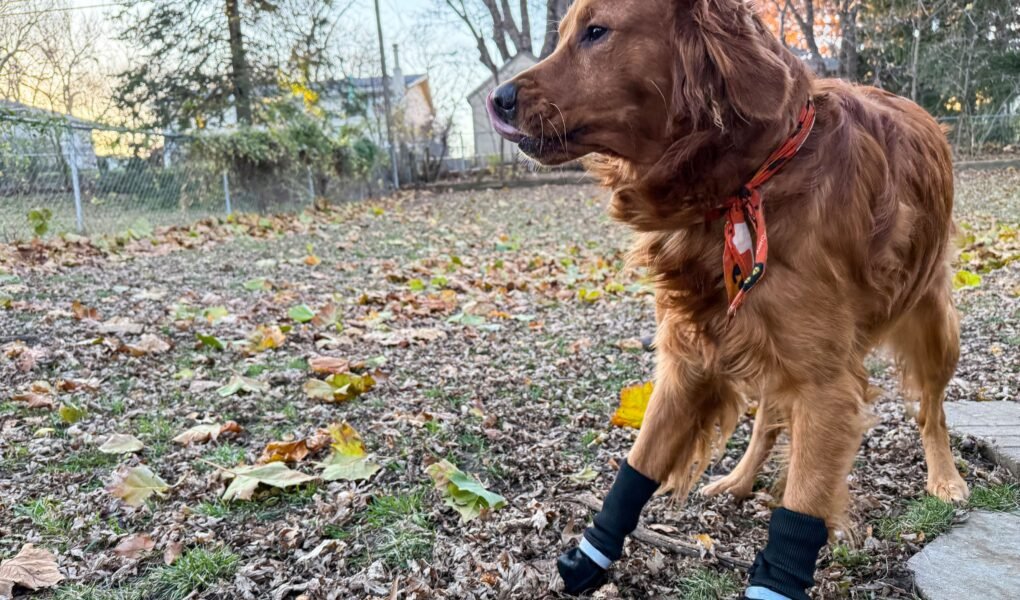
Buying footwear for your four-legged friend can feel like a gamble. You guess a size, wait for delivery, and then spend ten minutes wrestling a confused pup only to find the boots slide right off the moment they start trotting.
It doesn’t have to be this way. finding the right size isn’t magic; it is a matter of accurate measurement and understanding how dog boots should actually fit. Unlike human shoes, which rely on the shape of the foot arch and heel, dog boots rely on width and secure fastening around the ankle to stay put.
A poor fit does more than just annoy you. Loose boots cause tripping hazards, while tight ones can restrict circulation or cause painful chafing between the toes. To get the most out of your summer adventures, you need accuracy. This guide breaks down exactly how to measure dog paws effectively and select the right size for breeds of all shapes and statures.
Why Accuracy Matters More Than You Think
Many pet owners assume that sizing is based on weight or breed. They might think, “I have a Golden Retriever, so I need a Large.” This is a common mistake. Paw size varies wildly even within the same breed. A working German Shepherd might have tighter, more compact paws than a Shepherd mix who spends more time indoors.
When you rely on weight alone, you risk getting gear that hampers your dog’s movement. Summer boots are designed to protect against hot pavement and sharp terrain. If the boot is too loose, debris like sand and pebbles can sneak inside, acting like sandpaper against the paw pad. If it is too tight, the breathable mesh cannot do its job, and heat gets trapped against the skin.
Getting the measurements right ensures you get secure-fit dog boots that act as a natural extension of your dog’s leg, allowing them to run, jump, and play without restriction.
Step-by-Step Measurement Guide
To get the perfect size, you need to ignore your dog’s weight and focus entirely on the physical dimensions of their paws. You will need a sheet of paper, a pen, and a ruler or tape measure.
Here is the most reliable method for measuring:
1. Prepare the Stance
Have your dog stand on a flat surface. This is crucial. When a dog is sitting or lying down, their paws are relaxed and smaller. When they stand, their weight splays the pads out, giving you the true “active” width of the foot. This spread is what the boot needs to accommodate.
2. The Tracing Method
Place a plain sheet of paper under one of the front paws. Lift the opposite paw so that more weight shifts onto the paw you are measuring. This simulates the spread of the paw when they are walking or running.
Use your pen to trace the outline of the paw. Keep the pen upright and vertical. If you angle the pen inward, you will get a measurement that is too small. If you angle it outward, it will be too big.
3. Measure Length and Width
Once you have your outline, take your ruler and measure the widest part of the paw print (width) and the distance from the back of the heel pad to the tip of the longest toe nail (length).
- Pro Tip: Don’t forget the nails! How to measure dog paws correctly involves including the nails in the length measurement, as the boot needs to house them comfortably without pressing against the nail bed.
4. Repeat for Accuracy
Dogs are wiggly creatures. It is easy for a paw to slip or a pen to jerk. Trace and measure at least three times to find an average. Also, measure both front and back paws. It is very common for dogs to have larger front paws and smaller back paws. If the difference is significant, you might need two different sizes.
Decoding the Size Chart
Once you have your numbers, it is time to look at the chart. Summer Dog Boots typically come in a numerical range, often starting from size 40# for smaller breeds and going up to size 90#.
The number usually corresponds to the internal width of the boot in millimeters. For example, a size 70# often fits a paw width of roughly 2.75 inches (7 cm). However, you should always consult the specific brand’s chart.
The “Slightly Larger” Rule
If your dog’s paw width falls exactly on a size cutoff, or in between sizes, always size up.
The interior of the boot needs to have just enough room for the paw to expand when it hits the ground. If you choose the exact measurement, the boot will be too tight once the dog puts weight on it. A little extra room allows for air circulation through the mesh fabric, which is vital for keeping paws cool on hot days.
Options for Big Breeds
Finding gear for larger breeds can be difficult. Many standard pet store brands stop at “Large,” which barely fits a Border Collie. However, high-quality manufacturers produce specialized dog shoes for large dogs that go up to size 90#.
These larger sizes are engineered differently. They often feature reinforced soles to handle the heavier impact of a big dog running and wider ankle openings to accommodate thicker legs. Whether you have a Great Dane, a Bernese Mountain Dog, or a hefty Rottweiler, accurate measurement ensures even the biggest paws get the protection they need.
Ensuring a Secure Fit
The measurement gets you the right shell, but the fastening system ensures performance. You want secure fit dog boots that won’t fly off when your dog gets the “zoomies” at the park.
Look for boots that feature a double-strap system. A single strap often creates a pivot point, allowing the boot to rotate or slip off. Two straps—usually high-strength Velcro—create two points of contact. One strap secures the boot around the ankle bone, while the other stabilizes the fit around the lower leg.
The “Tongue” Test
When putting the boots on, the opening (or tongue) should pull back wide enough that you can slide the paw in without forcing it. If you have to shove or twist the paw to get it inside, the boot is likely too small or the design is poor.
Once the boot is on and strapped tight, you should be able to fit the tip of your pinky finger between the strap and the dog’s leg. It needs to be snug enough to stay put, but not so tight that it cuts off blood flow.
Common Sizing Challenges
The Dewclaw Dilemma
If your dog has dewclaws (that extra thumb-like toe higher up the leg), you need to be careful with the strap placement. Ensure the straps sit either above or below the dewclaw, never directly on top of it. Constant rubbing on the dewclaw can cause pain and injury.
Excess Fur
For fluffy breeds like Samoyeds or Sheepdogs, you might be tempted to size up significantly to fit all the hair. While you need a little room, rely on the straps to compress the fur. If you size up too much for hair, the sole of the boot will be too big, causing the dog to trip.
Conclusion
Taking five minutes to measure your dog’s paws properly can save you weeks of returns and exchanges. It transforms the experience of wearing shoes from a clumsy struggle into a comfortable routine.
Whether you are looking for dog shoes for large dogs or tiny booties for a terrier, the principles remain the same: measure the width under weight, account for the nails, and look for adjustable, dual-strap designs. With the right fit, your dog can safely navigate hot pavement, rocky trails, and summer adventures with confidence.