When utilities plan an advanced metering infrastructure (AMI) project, most of the attention goes to the meters. Yet the part of the system that most often determines long-term success is the communication network that carries data from each meter back to the utility. The network decides how often meters can report, how long batteries last, how reliable coverage will be in basements and meter pits, and how much the utility will pay every year for decades.
This article compares the main AMI network options, explains their trade-offs, and offers a practical framework for choosing between them.
What an AMI Network Has to Do
An AMI network carries readings, alarms and status data from meters to a head-end system, and carries commands such as configuration changes, on-demand reads and remote disconnects back to the meters. For water and gas meters, which usually run on batteries, the network must do this while consuming very little power, often for 15 to 20 years without a battery change.
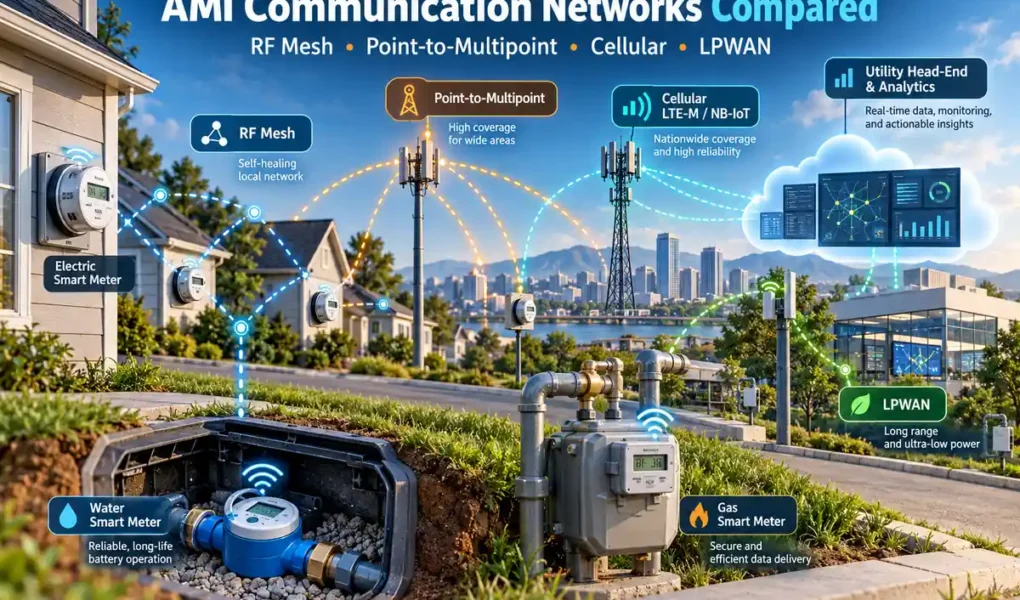
The Four Main Network Types
| Network Type | How It Works | Strengths | Weaknesses | Typical Fit |
|---|---|---|---|---|
| RF mesh | Meters and relays pass data to each other and to collectors, forming a self-healing web | Robust in dense areas, utility-owned, supports high data rates | Battery-powered water meters often cannot act as relays, needs many nodes, harder in sparse areas | Electric utilities and dense urban water systems |
| Point-to-multipoint (tower-based) | Meters talk directly to a small number of high-mounted base stations, often on licensed spectrum | Long range, few infrastructure sites, good battery life | Requires tower sites and possibly spectrum licenses, coverage gaps in difficult terrain | Water and gas utilities covering mixed urban and rural territory |
| Cellular (LTE-M, NB-IoT) | Meters connect directly to a commercial mobile network | No utility-owned infrastructure, fast deployment, carrier handles maintenance | Recurring per-meter fees, dependence on carrier network changes and sunsets | Utilities that prefer operating costs over capital costs, scattered service areas |
| LPWAN (for example LoRaWAN) | Low-power, long-range radio to gateways, usually in unlicensed spectrum | Very low power, inexpensive gateways, open standards available | Low data rates, interference risk in unlicensed bands, public networks vary by region | Smart city programs and utilities wanting open ecosystems |
Key Evaluation Criteria
1. Coverage in Real Meter Locations
Water meters sit in concrete pits, under metal lids, in basements and behind buildings. A network that looks perfect on a coverage map can struggle in these locations. Always run a propagation study and a field pilot in the most difficult part of your service area, not the easiest.
2. Battery Life at the Required Data Frequency
Every transmission costs energy. A network that supports hourly reads with a 20-year battery life is very different from one that achieves 20 years only with daily reads. Ask vendors to state battery life at the exact data profile you intend to use.
3. Total Cost of Ownership
Utility-owned networks carry higher upfront capital cost but low recurring fees. Cellular networks shift cost into monthly charges that add up over 20 years. Compare the full lifecycle cost, including tower leases, backhaul, software licenses, carrier fees and eventual replacement.
4. Technology Longevity
Utilities have been burned before when older cellular generations such as 2G and 3G were shut down, stranding meters that relied on them. Ask how the vendor will handle network evolution over the life of the endpoints and who pays if hardware must be replaced.
5. Cybersecurity
AMI networks are critical infrastructure. Look for end-to-end encryption, secure key management, authenticated firmware updates and alignment with recognized frameworks such as NIST guidance for smart grid cybersecurity. Remote disconnect capability in particular must be tightly protected.
6. Interoperability
Proprietary networks can lock a utility into a single meter vendor for decades. Open or standards-based approaches give more flexibility in future procurements.
Hybrid Networks Are Common
Many utilities end up with more than one network type. A tower-based network may cover most of the territory, with cellular endpoints filling in hard-to-reach meters. Some systems also allow drive-by collection as a fallback. Designing for hybrid operation from the start avoids costly workarounds later.
Utilities that want support planning and deploying a complete advanced metering infrastructure (AMI) can work with experienced providers such as MAYA Global Group, which pairs smart meter deployment with a deep understanding of the water networks those meters serve.
Getting Value From the Data
The network is only the pipeline. The real benefits of AMI come from what the utility does with the data: identifying customer-side leaks within hours, detecting reverse flow and tampering, building accurate district water balances, and giving customers daily usage information that encourages conservation. Plan the analytics and the staff processes alongside the network, or the data will simply accumulate unused.
FAQs
Which AMI network is best for water utilities?
There is no universal answer. Tower-based and cellular networks are popular for water because battery-powered meters cannot easily act as mesh relays, but the right choice depends on geography, density and budget.
What happens if a cellular network is shut down?
Meters that depend on a retired cellular technology can lose connectivity. Contracts should address how such transitions are handled and who bears the cost.
How long does an AMI deployment take?
For a mid-sized utility, full deployment often takes two to four years, including planning, pilot, network build-out and meter installation.
Conclusion
The meters get the attention, but the network is what an AMI system lives or dies by. By testing coverage in real meter locations, demanding honest battery-life figures, comparing lifecycle cost and planning for technology change, utilities can choose a network that will serve them reliably for the full life of their investment.